
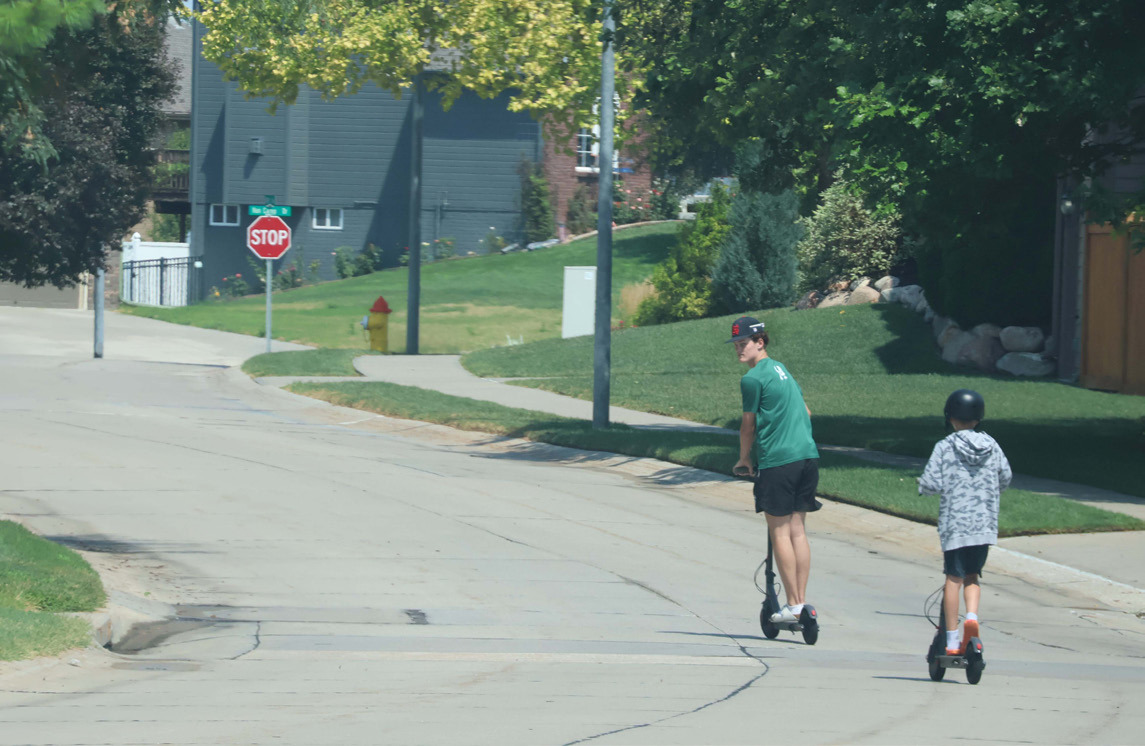
 Above left: Two boys ride their e-scooters near 192nd Street and West Center Road in Omaha. Photos provided by Flatwater Free Press.
Editor’s Note: Although this article is about the Omaha area, this topic is a statewide problem affecting all towns.
Jack Shotbolt was driving through his west Omaha neighborhood in early June when a girl, maybe age 10, shot out in front of him on an electric scooter.
He slammed on the brakes. His wife grabbed the dashboard. If he had been going a few miles per hour faster, Shotbolt thinks, he would have hit the girl.
After several chilling encounters with e-scooters and e-bikes, Shotbolt said he’s now on constant high alert behind the wheel. Every day, he sees at least a dozen kids on e-rides, many without helmets and turning wide “right into anything.”
“I want to see them outside (and) I want to see them safe,” Shotbolt said. “But if you were to hang out here for an afternoon, your jaw would hit the floor.”
“These kids are just on the loose.”
As a parent of five grown children, Shotbolt said he would never be the same if he were to accidentally hit a kid.
Last month, Shotbolt’s nightmare became another driver’s reality.An 11-year-old boy named Logan Rahn died after a pickup truck collided with his electric scooter in Bennington.
The exploding popularity of e-scooters and e-bikes has created a new danger on Omaha’s neighborhood streets — both for the kids riding them and the adult drivers braking and swerving to avoid them.
Local hospitals are treating increasing numbers of e-riders for concussions, fractured skulls and broken legs.
Police and lawmakers are scrambling to catch up with a technology that has outpaced policy and given grade schoolers access to a new level of speed.
Parents hoping to get their kids off screens and into the outdoors aren’t sure what to make of the trendy but potentially unsafe two-wheelers that blur the lines between toy and motor vehicle.
Many agree that something needs to change — whether that be the regulations or the supervision and guidance of children.
“You want to give your kids a little bit of freedom, and you hope and trust that they’re doing all the things you’ve told them to do,” said Sara Dettmer, a Bennington mother of two kids with e-rides. “But sometimes, you can’t be there every moment of every day.”
Behind the craze
Jamie Bowcott recognized the potential danger when he bought his adolescent sons electric scooters last summer. But the Millard father also saw certain benefits: He might save time on transportation, and his boys would get to move around the neighborhood more freely.
Bowcott and his wife talked with their kids about safety before they started riding, including wearing a helmet and staying off major streets. But recent accidents have heightened their awareness.
“I wouldn’t be upset if we got rid of them, but I also recognize that all their friends have one and that seems to be their communal way of getting around,” Bowcott said. “They have bikes, but they’re not as ‘cool’as riding scooters with their friends.”
Gas-powered dirt bikes and ATVs have been popular with kids in rural areas for decades, but until recently, it was rare to see underage riders on public streets, said Douglas County Sheriff Aaron Hanson.
The advent of charge-at-home electric dirt bikes and e-scooters removed the barrier of fueling up at a gas station that deterred most kids, Hanson said.
The first electric dirt bikes, often called “e-motos,” started showing up in Omaha around 2017, but weren’t widely available at first, said Zach McCauley, an e-bike seller and enthusiast. Their meteoric rise, McCauley said, can be traced to Sur Ronster, a You-Tuber known by his four million followers for popping wheelies on e-motos.
Rental e-scooters landed on Omaha sidewalks in 2019 just as lithium-powered scooters hit the shelves at big-box retailers.
Today, e-rides are affordable to the average family and sold at dozens of local stores and online outlets.
Target, for instance, sells one $300 electric dirt bike capable of traveling 16 mph — marketed to riders as young as 3. Several e-ride retailers, including Target, did not respond to requests for comment. Last year, e-motos “were under so many people’s Christmas trees” in Omaha’s suburbs, McCauley said.
Bikes, Motos and Scooters
The public discourse on regulating e-rides is muddied by confusion around the terms used to distinguish different types of vehicles, said Julie Harris, the director of Bike Walk Nebraska.
To Harris, an e-bike is most similar to a bicycle — it has pedals plus a battery that kicks in to assist. An e-moto, by contrast, is more like a dirt bike since it has no pedals, she said.
But some vehicles that Harris would classify as e-motos are marketed as e-bikes. That’s misleading, she said, since many e-motos can top out at much higher speeds than human-propelled e-bikes.
E-scooters are more straightforward, but some are much faster than others. Those designed for elementary school kids often come with a max speed of about 5 mph, but the speediest models can travel upward of 50 mph.
“At the end of the day, we need to be watching out for each other on the road,” Harris said. “It doesn’t matter what the device is.”
Standing in her front yard in Bennington, Dettmer said she sees kids texting, doing wheelies and riding helmetless while on their electric scooters and electric bikes. More often than not, she said, the unsafe behavior seems to outweigh the safe.
Her own kids — ages 6 and 9 — have an electric scooter and an electric pedal bike with top speeds that reach 7 and 10 mph. She said they never ride without parental supervision and helmets.
When news broke of Rahn’s death, Dettmer said it was “heartbreaking” for the community and also served as a wake-up call for many parents. She said her kids are now more wary of their e-rides. “Seeing some of the things that have happened and seeing how kids are using them, it’s been a complete turn off for our family, where we will not probably entertain ever getting another electric vehicle,” Dettmer said.
Speed is considered the difference that makes new-age e-rides more dangerous than traditional bikes and scooters.
Kids who aren’t trained in the rules of the road can now drive at the speed of car traffic on e-motos that aren’t equipped with basic safety features such as lights and mirrors, Hanson said.
Data from Nebraska Medicine shows that 68 e-scooter and e-bike-related trauma injuries were treated between 2021 and 2025. Nearly 80% came in the last two years, and many were kids and young adults without helmets.
Through May of this year, Nebraska Medicine has treated 22 trauma patients who sustained injuries from e-scooters and e-bikes. Scott Brown, trauma outreach and injury prevention coordinator at Bergan Mercy, said what used to be toys for kids are now “powerful machines.” Brown said head injuries are the most concerning because they can “significantly debilitate” people for the rest of their lives.
Regulating a moving target
As he headed toward Bellevue City Hall, Councilman Don Preister came across a now-familiar sight on one of the busiest streets in town. A couple of young people were riding through Harrison Street traffic on motorized minibikes without helmets, he later recounted to his colleagues, “I was scared for their lives,” Preister said.
Riding an off-road motorbike on public streets already is illegal under state law, but Bellevue doubled down last month amid growing public complaints to police. The city banned all off-road recreational vehicles, including minibikes and electric motorcycles, from being ridden on public streets, sidewalks and trails. E-scooters can operate on sidewalks but not streets.
Violators — and parents of kids who break the new law — can be charged with a misdemeanor, but the main emphasis will be on educating the public and protecting kids, Bellevue Police Chief Ken Clary said.
“If anybody thinks we’re heavy-handed, we’re not trying to be heavy-handed. We’re just trying to have their kids be safe,” Clary told the City Council. “This is 95% children, small kids.”
In Nebraska’s biggest county, Douglas County deputies began a crackdown in May on illegal dirt bike riding. The Sheriff’s Office has since cited 12 parents on suspicion of violating state law and impounded 13 vehicles — 11 electric and two gas-powered.
But more enforcement isn’t the whole solution, according to law enforcement and safety advocates: Local and state laws need to catch up with the rapid technological advancements of the e-ride industry.
E-scooters are classified similarly to bicycles in state law, but that doesn’t reflect how fast some models can go now, said Hanson, the Douglas County sheriff. The Nebraska Legislature will probably have to create new rules of the road for e-scooters, he said.
Bike Walk Nebraska recently received funding from the Metropolitan Area Planning Agency to develop state and local policy recommendations for e-bikes, e-motos and e-scooters.
“The market has outpaced the policy, and we've got to figure out how to kind of rebalance that,” said Harris, the Bike Walk director.
Before an e-scooter accident cut Logan Rahn’s life short, the 11-year-old was “a best buddy” to a lot of hockey players, said Molly Diamond, house commissioner of the Omaha Hockey Club.
“He was just good people,” Diamond said tearfully. “He was just the kind of kid that you wanted to have on your team because he brought everybody else around him up.”
When news broke of Rahn’s death, Dettmer said it was “heartbreaking” for the community and also served as a wake-up call for many parents. She said her kids are now more wary of their e-rides.
“Seeing some of the things that have happened and seeing how kids are using them, it's been a complete turn off for our family, where we will not probably entertain ever getting another electric vehicle,” Dettmer said.
The Flatwater Free Press is Nebraska’s first independent, nonprofit newsroom focused on investigations and feature stories that matter.