
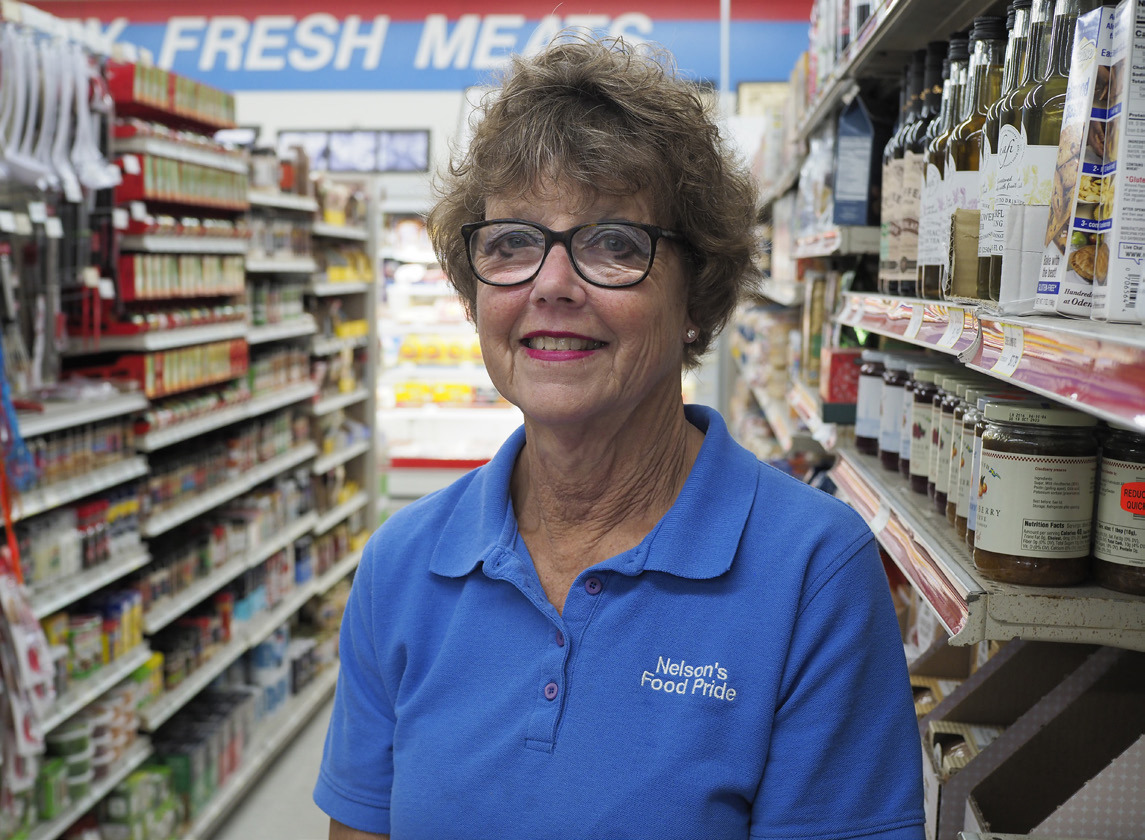
 Above: Nelson’s Food Pride grocery store owner Julie Johnson stands in the aisle with Swedish goods at her family’s grocery store in Oakland. She tries to know the name of every customer who enters. “That’s small-town business,” she said. “Somebody has a birth and we hug them, and they have a death and we hug them.” Photo by Jerry L Mennenga for the Flatwater Free Press
OAKLAND — If you drive down U.S. Highway 77, you won’t see the grocery store that has managed to keep afloat in this town for more than 100 years. It’s five blocks off the highway, on Oakland’s main drag.
What you will see is a bright yellow sign, beckoning highway drivers to make a pit stop. You’ll see the beige cinder block storefront and metal warehouse walls plopped between cornfields and the highway.
In small-town Nebraska, it’s an instantly recognizable sight.
It’s the Dollar General. Over the past 25 years, Dollar General stores have become a fixture of the retail landscape in rural Nebraska. In 2000, the only Dollar Generals in the state were in or surrounding Omaha and Lincoln, according to a Flatwater Free Press analysis of Nebraska grocery store permits.
Now, there are 142 chain “dollar” stores — 115 of them Dollar Generals — located in Nebraska towns with a population smaller than 10,000.
In that same amount of time, the number of grocery stores in those small cities and villages has shrunk from 326 to 272.
“Agrocery store is about quality of life,” said Charlotte Narjes, an University of Nebraska-Lincoln expert in helping rural grocery stores stay sustainable. “It truly is an anchor institution for many of our rural communities.”
Local grocery stores matter, experts say, because they’re often a community gathering space and often the last line of defense keeping a town from becoming a “food desert” where residents can’t get affordable fresh foods. They also keep money in the local economy and help stem population loss.
But it’s becoming harder to keep those rural grocery stores open, owners and advocates say, citing a growing list of challenges including slim profit margins. Small-town stores face higher wholesale costs than big-box stores. A generation of owners is aging out, their customer base is shrinking and there aren’t many people willing to risk buying a store.
The proliferation of Dollar Generals — often a cheaper competitor — tacks one more challenge onto that list.
“We hear a lot about rural brain drain,” said Jillian Linster, senior policy director at the Center for Rural Affairs in Lyons. “But the catch is, if you want people to come and live and work in your community, they have to have a place to shop for food.” **** The walls of Nelson’s Food Pride in Oakland are filled with framed yellowing newspaper clippings — 20th-century ads, old stories about grand openings and new locations.
Julie Johnson is the third generation in her family to run the Oakland grocery store. When she retires, her son will become the fourth.
She greets those who come in as they shop for cases of water, boxes of frozen pizza rolls, cartons of berries. In this town of 1,359, Johnson knows most everyone’s name, and feels guilty when she doesn’t.
But for the past few years, Johnson says, traffic in and out of the family grocery store has been sparse.
Through the 1980s and ’90s, she watched as the Walmarts, Menards and Costcos of Fremont and Omaha started siphoning off her customers.
That big-box expansion focused on larger communities, cities with populations between 10,000 and 50,000, said Kennedy Smith, a senior researcher for the Institute for Local Self-Reliance, which promotes local community development.
Big-box stores hurt but didn’t actually move into places like Oakland.
Then Dollar General came to town.
It came to many small towns, a previously untapped market.
“That’s why I think Dollar General has gravitated here,” Smith said. “They tend to look for communities where they don’t think they’ll have a lot of competition.”
Chain dollar stores like Dollar General and Family Dollar saw the second-largest food retailer growth behind supercenters like Walmart from 1990 to 2015, according to the U.S. Department of Agriculture. And the Dollar General model appears laser focused on rural America — as of 2022, three-quarters of Dollar Generals were in communities smaller than 20,000 people, according to a Forbes analysis. In Nebraska, 75% of Dollar General locations are in a town smaller than 10,000 people.
That can come at the expense of local grocers, a USDA study found last year.
When a dollar store enters a rural community, local grocery stores are 5% more likely to close, according to the decades-long analysis, and their sales declined by 9.2% on average.
In big cities, the impact of a dollar store wore away after about five years, research showed. But the effects were lasting in small towns.
“A full-service grocery store operates on extremely thin profit margins,” Smith said. “They might make 1% or 2% profit on their sales annually. And so it doesn’t take a whole lot of cutting into their sales for that business to be at risk.”
At Laurel’s Hometown Market, owner Brenda Whalen didn’t think the Dollar General cut much into her business. Sometimes, it seemed to bring her business — people would come to town to stop by Dollar General, then the grocery store for steaks and fresh produce.
But last summer, the Dollar General closed for days because of air conditioning problems. And Whalen realized her aisles were suddenly busier.
“Our sales those days were phenomenal,” Whalen said.
Even as it competes with some local grocers, Dollar General is getting help from Nebraska taxpayers.
In 10 communities across Nebraska, Dollar General has saved $801,335 in tax credits through tax increment financing since at least 2012, according to annual TIF reports.
The state has also put money toward Dollar General’s operations — in 2020, the Department of Economic Development awarded $500,000 in building development funds to Washington County’s economic development corporation, helping to build an 85-acre Dollar General distribution center in Blair.
In an email statement, Dollar General noted that the company foundation has awarded more than $300,000 to literary programs in Nebraska in the past five years and donated hundreds of thousands of pounds of food to local food banks. The company said that when it opens a new location, that store provides jobs, tax money for the local economy and access to affordable products for local customers, including food.
“While we are not a grocer, we understand the importance our stores play in providing affordable and convenient access to everyday household items, including nutritious foods, often in communities where other retailers cannot or will not serve,” Dollar General said in the statement.
**** The buildings are often aging. In Laurel, Whalen has put thousands toward fridge and electrical repairs.
“Everything that breaks down all the time just kills us,” she said. “You can’t get ahead when you’re trying to put all the money into repairs and making things look a little nicer and better.”
Whalen and her husband also owned a grocery store in neighboring Coleridge for two years. The expenses started to rack up.
“We weren’t losing a ton of money, but we weren’t making much, either,” Whalen said. “So the bank said, ‘You guys really need to think about closing that door.’” In Oakland, all those stores, save for Nelson’s Food Pride, are gone now. The hospital was torn down, too, replaced with a medical clinic and pharmacy.
To lose the grocery store?
Nelson’s Food Pride is one giant, remaining piece.
“That would be the worst thing that could happen to our town,” Penke said.
Editor’s note: We checked with Osceola Food Mart (Central City Mall) and Morgan (sales) noted some differences. She said while it’s harder to find help, people note that they treat their employees better than Dollar General. At the local grocery store, you’re a person while at Dollar General you’re just a number. She also noted different products they carry now to compete with Dollar General. She is purchasing cheaper Halloween merchandise to compete. She thought the Food Mart’s revenue took a hit the first year, about $5000-$10,000.
The Flatwater Free Press is Nebraska’s first independent, nonprofit newsroom focused on investigations and feature stories that matter.